
- What Actually Counts as an Outdoor Daybed
- Mattress Cushion, Back Cushions, and Bolsters — What Each One Does
- Measure the Frame, Not an Old Compressed Cushion
- Choosing Thickness for Sitting and Napping
- One-Piece Mattress or Multiple Sections?
- Best Fabrics for Sun, Rain, and Pool Areas
- Seat and Back Cushion Firmness
- Keeping Large Cushions From Sliding Around
- Five Styling Directions Worth Considering
- Storage and Seasonal Care
- Outdoor Daybed Cushion FAQ
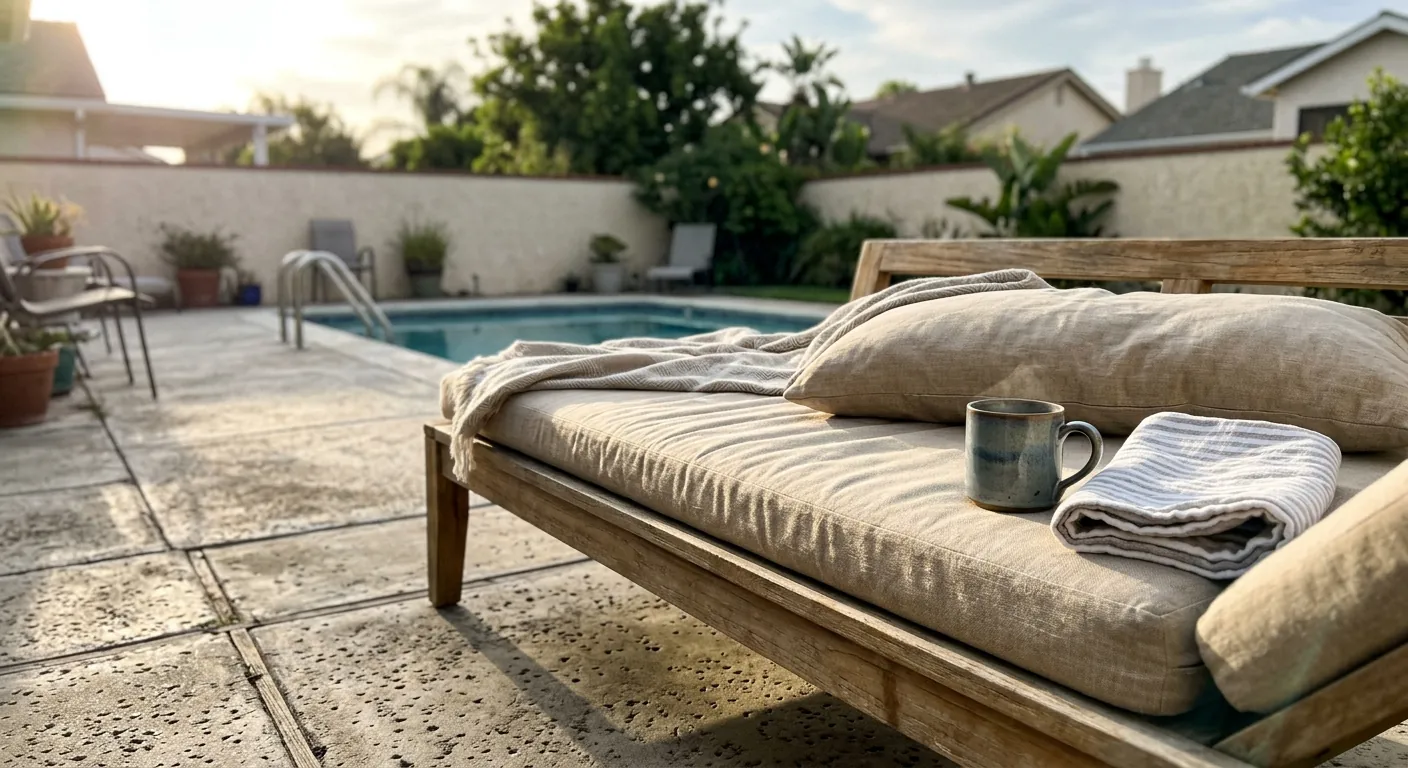
We get a version of the same email every June: “I bought a daybed frame, and the cushion that came with it is basically a yoga mat.” Most stock daybed cushions are 3 to 4 inches of low-density foam wrapped in whatever fabric was cheapest that quarter. They’re fine for looking at in a showroom. They’re not fine for a Saturday afternoon nap, which is presumably the point of owning a daybed in the first place.
What Actually Counts as an Outdoor Daybed
The term gets used loosely, so it’s worth being specific before you order anything. An outdoor daybed is a low, wide frame — usually somewhere between 39 and 78 inches wide, sometimes bigger for sectional-style builds — meant to work as both a couch during the day and a lounger or sleeping surface later on. That’s different from a chaise, which is narrower and built for one body lying flat, and different from a bench, which usually skips the reclining function altogether.
Because a daybed has to do both jobs, the cushion system usually isn’t one flat pad. It’s a mattress cushion for the base, plus back cushions or a bolster arrangement that turns the flat surface into something you can lean against. We build a lot of these for custom daybed cushions, and the request almost always includes both pieces — rarely just the mattress alone.
Mattress Cushion, Back Cushions, and Bolsters — What Each One Does
The mattress cushion is the main event: it covers the full sleeping/sitting surface and takes most of the wear. Back cushions sit against the headboard or rail and give you something to lean on while the daybed is being used as seating. Bolsters are the round or wedge-shaped cushions at the ends — optional, but they do a real job of keeping you from sliding off the side when the daybed doubles as a nap spot.
A lot of buyers only budget for the mattress piece and then wonder why the daybed feels unfinished once it’s set up. If you’re planning to actually sit on this thing in the evenings rather than just lie on it, the back cushions aren’t optional — they’re what makes the sofa function work at all.
Measure the Frame, Not an Old Compressed Cushion
This is the single most common mistake we see in daybed cushion orders. If your frame came with a cushion that’s a few years old, don’t measure that cushion — measure the frame’s actual sitting/lying area. Foam compresses over time, sometimes losing half an inch or more, and a new cushion built to match the old compressed dimensions will be loose and shift around inside the rails from day one.
Measure the interior length and width of the frame at the base, then measure again at the rail height if the sides taper inward or outward. If your daybed has rounded corners or an angled headboard, note that too — a squared-off cushion inside a curved frame leaves gaps that collect leaves and rainwater. Our measuring guide walks through this step by step, including how to handle daybeds with irregular shapes.
Choosing Thickness for Sitting and Napping
Thickness is where daybed cushions diverge most from regular seat cushions. A dining chair cushion at 2 inches is perfectly comfortable because your back is doing the supporting. A daybed cushion at 2 inches over a hard slatted base feels like sleeping on a picnic table — you’ll feel every slat by the second hour.
For a daybed used mainly as extra seating, 4 inches is a reasonable minimum. For one that gets used for actual napping or the occasional overnight guest, we usually recommend 5 to 6 inches, sometimes with a firmer support layer at the bottom and a softer comfort layer on top. That combination holds its shape under regular use instead of flattening into a trough down the middle within a season.
| Primary use | Suggested thickness | Notes |
|---|---|---|
| Occasional overflow seating | 4″ | Fine over a solid or slatted base |
| Daily lounging, reading, TV outside | 5″ | Good middle ground for most households |
| Regular napping or overnight use | 6″ | Consider a dual-density foam core |

One-Piece Mattress or Multiple Sections?
For daybeds under about 60 inches wide, a one-piece mattress cushion usually looks cleaner and has no seam to trap dirt or water. Past that width, though, a single foam slab gets heavy, awkward to flip for cleaning, and genuinely difficult to ship and unpack — a full-size one-piece cushion arriving compressed in a box doesn’t always spring back to its original shape right away, and some customers find that unsettling even though it’s normal.
Splitting the mattress into two or three sections solves most of that. It’s easier to carry, easier to rotate for even wear, and if one section ever needs replacing you’re not re-ordering the whole cushion. The tradeoff is a visible seam line and, if the sections aren’t tied or zipped together, a small gap that can open up under movement. We generally recommend sections for anything over 65 inches and a single piece below that, though it does come down to how the daybed will actually be used.
Best Fabrics for Sun, Rain, and Pool Areas
Daybed cushions spend more consecutive hours in direct sun than almost any other outdoor cushion, simply because of the surface area involved, so fabric choice matters more here than it does on a smaller chair cushion. Solution-dyed acrylic and solution-dyed polyester are the two fabrics we point people toward most often — the color pigment is added while the fiber is still liquid, so it runs all the way through the strand instead of sitting on the surface, which is why these fabrics hold their color noticeably longer than fabric that’s dyed after weaving, as Revolution Fabrics explains in its outdoor fabric guide.
For poolside daybeds specifically, prioritize fast-drying fabric and, just as importantly, fast-drying foam underneath it. A gorgeous fabric over standard closed-foam will still stay damp and start to smell after a week of splashes and pool days. Reticulated, open-cell foam drains water straight through instead of holding onto it, which is the difference between a cushion that’s dry by lunch and one that’s still soggy at dinner — Sailrite’s foam guide has a good breakdown of how that open-cell structure works if you want the technical side of it.
If your daybed sits under a pergola or covered porch and rarely sees direct rain, you have more room to choose based on hand-feel and color rather than pure performance. Full-sun, uncovered patios and pool decks don’t give you that luxury — that’s where the performance fabric earns its higher price. Browse the full range on our fabric swatches page before you commit to a color.
A quick honest note on timing: because every daybed cushion is cut to your frame’s exact dimensions, it isn’t sitting on a shelf waiting to ship. Most orders take roughly 10 days from the day you confirm your measurements to the day it lands on your porch. Worth building into your patio-season planning if you’re aiming for a specific date, like a graduation party or a Fourth of July gathering.
Seat and Back Cushion Firmness
Firmness for the mattress cushion and firmness for the back cushions usually shouldn’t match. The mattress needs enough give to feel like lounging, not so much that you sink and your lower back complains after twenty minutes. Back cushions can run a little softer since they’re taking less direct body weight and mostly need to feel inviting to lean against.
If you’re torn between two firmness levels for the mattress cushion, go firmer rather than softer. Foam softens naturally with UV exposure and use over a couple of seasons, so a cushion that starts out medium-firm tends to land in a comfortable middle ground by its second summer, while one that starts soft can end up feeling collapsed.
Keeping Large Cushions From Sliding Around
The bigger the cushion, the more surface area catching wind, and the more annoying it is when it slides three inches to the left every time someone sits down. Ties at the corners are the simplest fix and work well on frames with slats or rails to anchor to. Hook-and-loop strips along the bottom edge are less visible and hold up fine on solid platform bases. For sectional mattress pieces, a short connector strap between sections keeps the seam from gapping when someone shifts their weight.
None of this is complicated hardware — it’s the kind of detail that’s easy to skip when you’re focused on fabric and color, and then genuinely annoying to live without once the cushion is on the frame.
Five Styling Directions Worth Considering
Daybeds have a lot of visible cushion real estate, which means the styling decision carries more weight than it would on a single chair. A few directions that consistently work well:
Tonal and quiet. One fabric across mattress and back cushions in a single neutral — sand, greige, a soft sage — reads calm and lets the surrounding plants or tile do the visual work.
Deep and pale, same family. Mattress in a deeper shade, back cushions and bolsters a few tones lighter in the same color family. Gives depth without introducing a second pattern.
Stripe plus solid. A striped mattress cushion with solid-color back cushions (or the reverse) is the classic coastal-daybed combination for a reason — it reads intentional without being fussy.
One accent bolster. Keep everything else neutral and let a single patterned or bright bolster carry the color. Easiest to change seasonally since it’s the smallest, cheapest piece to swap.
Warm textural neutrals. Rather than leaning on our own #f39800 accent, this direction pairs a warm terracotta or rust bolster with a heavier woven-look fabric on the mattress — less about bright color, more about texture doing the visual work.

Storage and Seasonal Care
Even weather-resistant fabric benefits from a break during the harshest months. If you get real winters, bring cushions inside or into a deck box once temperatures start dropping consistently below freezing — repeated freeze-thaw cycles are harder on foam than sun exposure is. In milder climates, standing cushions on edge during heavy rain stretches helps them drain and dry faster than leaving them flat.
For everyday care, a quick hose-down and air-dry handles most dust and pollen. For deeper cleaning, mild soap and a soft brush work on solution-dyed fabrics without stripping color, though it’s worth checking your specific fabric’s care instructions first since backing and coatings vary. If a cover ever needs replacing separately from the foam, that’s usually a sign the foam itself is worth checking too — the two tend to age together.
Outdoor Daybed Cushion FAQ
How many back cushions do I need? A rough rule: one back cushion per 24 to 30 inches of daybed width. A 60-inch daybed usually looks and functions best with two, while anything past 78 inches often calls for three, or two larger cushions plus a bolster at each end.
Can I use indoor foam and just cover it in outdoor fabric? Technically yes, but we don’t recommend it. Standard foam holds moisture and will mildew from the inside even under a good outdoor cover, since the fabric only protects the surface, not what’s happening inside the cushion.
Will a custom daybed cushion fit if my frame is slightly irregular or handmade? That’s actually where custom cushions matter most — pre-made sizes assume standard dimensions, and a lot of daybed frames, especially built-in ones, don’t follow a standard at all. Send over your measurements and we’ll build to the actual frame.
Do I need bolsters, or are they just decorative? They’re functional if the daybed gets used for napping — they keep you from rolling off the edge and give your arm something to rest on while seated. If the daybed is purely decorative seating, they’re more optional.
If you’re outfitting the rest of the patio at the same time, our outdoor cushions collection covers everything from chair pads to bench seating, and a few custom throw pillows in a contrast color are usually the easiest way to tie the daybed back into the rest of the seating area. For anything frame-specific that doesn’t quite fit a standard product listing, our FAQ page covers most of the odd questions that come up during ordering.
Ready to build your set? A full daybed cushion order includes a fitted mattress cushion, coordinated back cushions, and optional bolsters, all cut to your frame and made in the same outdoor performance fabric — start with your measurements here.