- What Makes Breakfast Nook Cushions Different?
- Measure Every Bench Section Separately
- One Long Cushion or Multiple Cushion Sections?
- How Thick Should Breakfast Nook Cushions Be?
- Choosing Foam for Daily Dining
- Best Fabrics for Spills, Crumbs, Children and Pets
- Box Edge, Knife Edge or Tufted Cushions?
- How to Keep Banquette Cushions from Sliding
- Breakfast Nook Color and Pattern Ideas for Every Season
- Common Ordering Mistakes
- A Few Options to Start From
- Breakfast Nook Cushion FAQ
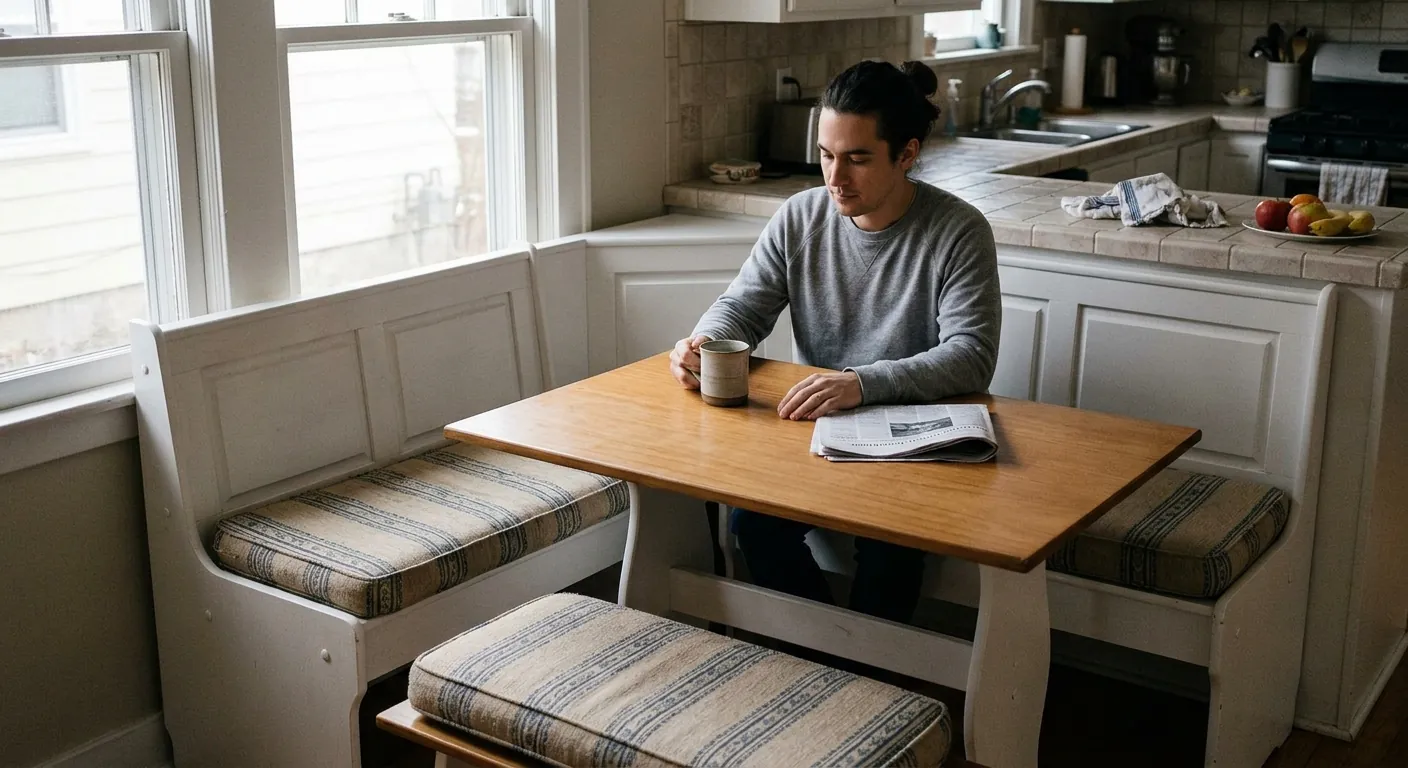
I get the same email at least twice a week: “I measured my nook, ordered a cushion online, and it’s about an inch short on one end.” Breakfast nooks are sneaky like that. They look like a simple bench, but between the wall angles, the table legs, and two facing seats that have to match up, there’s a lot more going on than a regular bench cushion job.
We build a lot of these at rofielty, and honestly the built-in banquette is one of the harder shapes we quote, right up there with wraparound porch seating. So instead of another generic “measure twice” post, I wanted to walk through the parts that actually trip people up — the corner, the thickness, the fabric, and the little details that decide whether your nook feels like a cozy diner booth or a cushion that’s technically the right size but sits wrong.
What Makes Breakfast Nook Cushions Different?
A patio bench cushion just needs to survive weather. A breakfast nook cushion needs to survive weather of a different kind — cereal bowls, dropped forks, kids climbing over the back to get to the window seat, and being sat on three times a day, every day, for years. It’s also almost always a fixed, built-in shape, which means there’s no returning it to a store shelf if the corner doesn’t sit flush.
Most nooks fall into one of three layouts: a straight bench against one wall, an L-shape wrapping a corner, or a full U-shape with two side benches and one facing the table. Each of those changes how the cushion should be built, which is really the whole point of this guide.
Measure Every Bench Section Separately
Here’s the mistake that causes the most headaches: measuring the whole run of a bench as one number and assuming the cushion will just fold around the corner. It won’t sit right. Built-in benches are almost never perfectly square — walls settle, trim gets added later, and a corner that looks 90 degrees on paper is sometimes 88 or 91 in real life.
Measure each straight section on its own, front edge and back edge separately, since older houses in particular tend to have benches that are slightly wider at the front than the back. If there’s a corner, decide upfront whether you want a single cushion piece that turns the corner, or two cushions that meet at the joint with a small gap or a mitered seam. Both work, but they’re built differently, so it’s worth deciding before you order rather than after.
If your setup is anything but a straight single bench, it’s worth working from a detailed cushion measuring guide rather than eyeballing it, since the guide walks through exactly where to pull the tape for corner and multi-section benches.

One Long Cushion or Multiple Cushion Sections?
People assume one continuous cushion always looks nicer, and sometimes it does. But there’s a practical downside — a single long cushion covering both sides of an L-shape is heavy to lift for cleaning, and it’s harder to replace later if only one section wears out or gets a stain that won’t budge.
Splitting the bench into two or three cushion sections, one per straight run, tends to hold up better over years of daily use, and it lets each piece be pulled off separately when you need to wipe underneath. The trade-off is a visible seam where sections meet. Most people don’t mind it once the cushions are in place, especially if the fabric pattern is solid or a subtle texture rather than something with an obvious repeat that needs to line up.
Whichever way you go, the two facing benches in a U-shaped nook should be ordered as a matched pair rather than two separate one-off orders, even down the road — small differences in foam batch or fabric dye lot are more noticeable side by side than most people expect.
How Thick Should Breakfast Nook Cushions Be?
This is where the table height really matters, and it’s the step people skip most often. Standard dining tables sit around 28–30 inches high. A comfortable seat height, cushion included, usually lands somewhere around 17–19 inches, which leaves roughly 10–12 inches of legroom under the table once you’re seated.
So before picking a foam thickness, measure from the floor to the top of the bare bench, then do the math backward from your table height rather than just picking “2 inches” because it sounds standard. If the bench itself already sits at 18 inches, a thick cushion is going to push knees uncomfortably close to the underside of the table. If the bench sits low, around 15–16 inches, a 3 to 4-inch cushion actually brings the seating to a much more natural height.
One detail that catches people off guard: if the nook has a back cushion too, the seat depth needs to account for that. A back cushion that’s 3 inches thick effectively shortens the usable seat depth by roughly that amount, so the seat cushion should be measured to the wall, not to where the back cushion will eventually sit.
Choosing Foam for Daily Dining
Outdoor cushions can get away with softer, lighter foam since they’re not sat on constantly. A breakfast nook is closer to dining chair use, honestly, so it needs foam that bounces back instead of holding a body-shaped dent by the second week.
High-density polyurethane foam, usually in the 1.8 to 2.5 lb/ft³ range, is the standard choice for this kind of daily seating. Anything lighter tends to flatten out within a year or so under regular use. Some people also like a firmer high-resilience foam core wrapped in a thin layer of softer foam on top, which gives a bit of give without the whole cushion feeling squishy after sitting on it through breakfast, lunch prep, and homework time later in the day.
Best Fabrics for Spills, Crumbs, Children and Pets
If there’s one place in the house where fabric choice actually matters more than color, it’s the breakfast nook. This is where spilled orange juice, ketchup, and muddy paw prints from the dog sneaking under the table all happen on a weekly basis.
Solution-dyed acrylic fabrics hold up especially well here, since the color runs through the entire fiber rather than sitting as a surface coating, so stains and scrubbing don’t wear the color away over time. Sunbrella’s own materials on performance fabric note that this kind of engineered fiber is what allows spills and muddy prints to be wiped clean with just soap and water rather than special cleaners. The category has kept expanding too, with trade coverage on Sunbrella’s newer interior-focused line pointing out how that same stain resistance is now showing up in softer, more home-friendly textures instead of just outdoor-grade canvas.
For a breakfast nook specifically, I’d lean toward a mid-weight woven fabric with a slight texture over anything glossy or heavily embossed — texture hides small crumbs and light scuffing far better than a smooth, shiny finish does. If you want to compare options side by side before committing, it helps to order a few stain-resistant fabric options and actually run a wet finger over them at home, since photos online rarely show how a texture really behaves.

Quick note while we’re on the topic — right now orders over $300 get $60 off, and orders over $500 get $125 off, which tends to cover a full nook set (two or three cushion sections plus a fabric upgrade) pretty comfortably.
Box Edge, Knife Edge or Tufted Cushions?
A knife-edge cushion (basically two flat panels sewn together at the edge, no side wall) gives a softer, more relaxed look and is usually the more budget-friendly build. A box-edge cushion, with a fabric wall running around the sides, holds its shape longer and looks a bit more tailored, which a lot of people prefer for a built-in nook since it echoes the clean lines of the bench itself.
Tufting — those little pulled-down buttons or stitched points — adds a diner-booth character that a lot of people love in a breakfast nook specifically, but it does reduce the padding slightly at each tuft point and makes the cushion a touch firmer there. Piping is mostly a visual call: a single contrast piping line along a box edge tends to look sharp without being fussy, while double piping or no piping at all reads more casual and relaxed.
How to Keep Banquette Cushions from Sliding
A cushion that slides forward every time someone gets up is one of the most common complaints we hear, and it’s a fixable one. Ties that anchor to the bench slats or back rail work well on benches with a back cushion, since they hold both pieces in place at once. On a bare bench with no back support, a non-slip rubber backing on the underside of the cushion does most of the work, especially paired with a snug (not loose) fit against the walls on either side.
The gap matters more than people think — a cushion cut even half an inch narrower than the actual bench width will shift over time, while one cut to the exact inside measurement, wall to wall, tends to stay put without needing anything extra at all.

Breakfast Nook Color and Pattern Ideas for Every Season
Nooks tend to be small, enclosed spots, so a bold pattern reads differently there than it would on a big living room sofa. A lot of our customers go one of two ways: a solid, slightly warm neutral that plays well with holiday table settings from Thanksgiving through the New Year, or a subtle stripe or check that adds interest without competing with everything else going on at the table.
If your nook faces a window, it’s worth thinking about how the fabric reads across the year — a deep terracotta or rust tone that feels cozy for a fall breakfast can look a bit heavy by mid-summer, while a soft sage or warm cream tends to carry through every season without needing to be swapped out. That said, some households do keep a lighter spring/summer cover and a warmer fall/winter one and just switch them, which is a nice option if you’ve got the storage space for it.
Common Ordering Mistakes
- Measuring the bench as one total length instead of section by section, especially around corners.
- Picking a foam thickness before checking table height, then finding knees hit the underside of the table.
- Forgetting to subtract back-cushion depth from the seat cushion measurement.
- Ordering two facing bench cushions at different times, which can result in a slightly different fabric dye lot.
- Choosing a smooth, glossy fabric that shows every crumb and water spot right away.
Most of these are easy to avoid once you know to look for them, which is really the whole reason this post exists — a cushion that’s “close enough” in a nook is a lot more noticeable than a cushion that’s close enough on a porch bench nobody stares at every morning over coffee.
A Few Options to Start From
Custom Breakfast Nook Cushions
Multi-section sizing for L-shapes and corners, 2–7 in. foam thickness options.
See configurator →Custom Bench Cushions
For straight benches, window seats, and single-run banquettes.
Build your cushion →Fabric Swatch Kit
Order a handful of stain-resistant fabrics to test at home before committing.
Order swatches →Breakfast Nook Cushion FAQ
How thick should a breakfast nook cushion be?
Most fall between 2 and 4 inches, but the right number depends on your bench height relative to the table — measure from the floor up before choosing.
Can I order two different cushion sizes for an L-shaped nook?
Yes, and for most L-shapes that’s actually the better approach — measuring and building each straight section separately, rather than one continuous piece, tends to fit corners more accurately.
What fabric holds up best against kids and pets?
Solution-dyed performance fabrics with a bit of texture tend to hide crumbs and light stains best, and they clean up with mild soap and water rather than special products.
Do I need a non-slip backing if the cushion already has ties?
Ties help a lot if there’s a back cushion to tie into, but a non-slip backing is still worth adding on bare benches, since ties alone don’t stop side-to-side shifting as much.
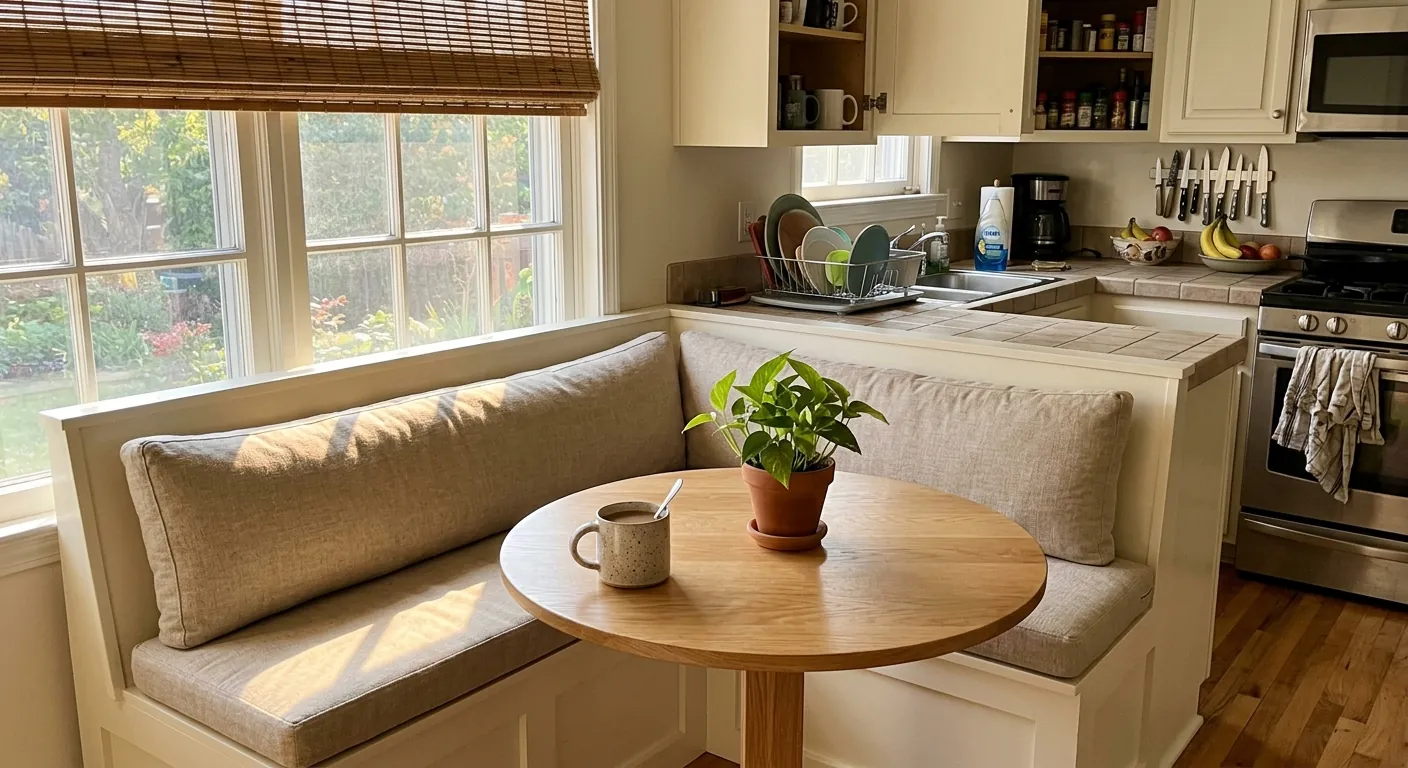
If your nook is anything other than a simple straight bench — an L-shape, a corner, two facing sides that need to match — it’s worth sketching it out before you order anything. Send us the sketch along with each section’s measurements and we’ll help you figure out where the seams should go and how thick the foam should be for your specific table height. It’s a lot easier to get right the first time than to redo it after the cushion’s already sitting there, an inch too short on one end.