
- Why Boat Cushions Are Different From Regular Outdoor Cushions
- What Type of Boat Cushion Do You Need?
- Custom Boat Cushions vs Standard Replacement Cushions
- How Thick Should Boat Cushions Be?
- What Foam Is Best for Boat Cushions?
- Best Fabric for Boat Cushions
- How to Keep Boat Cushions From Sliding
- How to Measure for Boat Cushions
- Boat Cushion FAQ
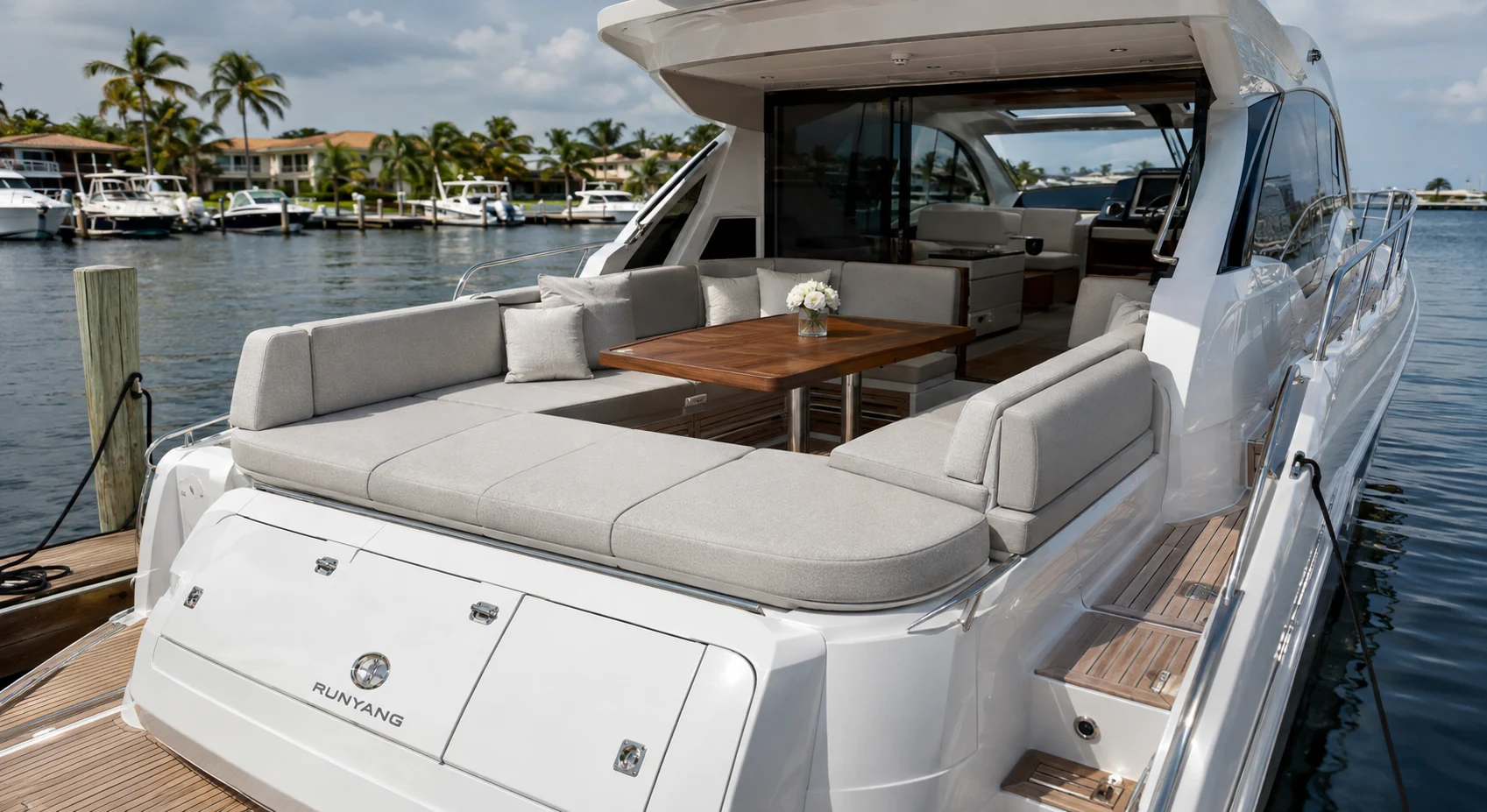
If you’ve ever sat down on a boat cushion that had gone stiff, moldy, or just plain flat after one Florida summer, you already understand why buying boat cushions is a different exercise than buying patio cushions. The two look similar in a photo. They are not similar once they’ve spent a season on the water.
I’ll walk through what actually separates marine cushions from everything else, the different types you’ll run into depending on where they sit on the boat, and how to decide between a standard replacement pad and something built to your exact seat. There’s also a section on foam and fabric that gets more specific than most guides bother to be, because “waterproof” on its own doesn’t tell you much.
Why Boat Cushions Are Different From Regular Outdoor Cushions
A patio cushion deals with rain and sun. A boat cushion deals with rain, sun, direct spray, standing puddles after a wake hits the deck, salt residue that never fully rinses off, and constant movement that grinds fabric against hardware. That’s a heavier workload, and it shows up fastest in two places: the foam and the stitching.
Regular outdoor foam can handle occasional dampness fine. What it struggles with is repeated soaking followed by slow drying in a closed cabin or under a cover. That combination is basically an invitation for mildew and a foam core that never quite dries in the middle, even when the surface feels fine to the touch. Marine-grade cushions are built around drainage and quick-dry cores specifically because boats don’t give a cushion the luxury of drying out between uses the way a covered porch does.

What Type of Boat Cushion Do You Need?
“Boat cushions” is really an umbrella term, and the right one depends entirely on where it sits and how it gets used.
- Boat Seat Cushions — general-purpose pads for individual seats, usually the first thing people replace when the original foam compresses.
- Cockpit Cushions — the bench and wraparound seating in the cockpit area, often the largest and most exposed pieces on the boat.
- Helm Seat Cushions — built for the driver’s position, so support and grip during movement matter more here than pure lounging comfort.
- Boat Bench Cushions — long, straight-run seating similar in shape to outdoor bench cushions, but built with marine foam and fabric.
- Bow Cushions — angled and often triangular or trapezoidal, following the shape of the bow deck.
- Sunpad Cushions — thicker, lounge-style pads meant for lying down rather than sitting upright.
- Cabin Cushions — interior seating and berth cushions that see less direct spray but still need moisture resistance from general humidity.
Knowing which category you’re shopping for narrows things down fast, because thickness, shape, and even fabric weight expectations shift depending on which of these you’re replacing.
Custom Boat Cushions vs Standard Replacement Cushions
This is where most people get stuck, so it’s worth being direct about it.
Standard, pre-sized replacement cushions make sense when your boat is a common, still-in-production model and the original manufacturer’s cushions are square, rectangular, or otherwise simple in shape. If a stock size gets close enough, there’s no real reason to pay more for custom work.
Where that logic breaks down is with older boats, models where the factory pad has been discontinued, or seating that isn’t a clean rectangle — curved corners, tapered bow shapes, trapezoidal helm seats, anything asymmetric. We hear a version of this constantly: someone spends an afternoon searching for a replacement that “should” fit, only to find the closest option is two inches short on one side or doesn’t account for a rounded corner at all. At that point, a custom boat cushion built from your own measurements stops being a luxury and starts being the only option that actually fits.
If your boat is more than a few years old, there’s a decent chance the original cushion pattern isn’t sold anywhere anymore. Custom sizing sidesteps that problem entirely since it’s built from your measurements, not a factory catalog number.
How Thick Should Boat Cushions Be?
Thickness gets glossed over in a lot of buying guides, which is odd, because it’s one of the more noticeable differences between “fine” and “actually comfortable” on a boat.
As a rough starting point: 2 inches works for auxiliary seating or thin backrests where deck space is tight. 3 inches is the most common choice for standard boat seats and holds up well for typical day-trip sitting. 4 inches starts to make sense once you’re spending several hours seated — longer fishing trips, cruising, that kind of use. 5 inches and up is really sunpad and lounge territory, where you’re lying down rather than sitting upright and want more give underneath you.
That said, thickness alone doesn’t determine comfort. Foam density and how the seat base itself is shaped matter just as much. A 3-inch cushion over high-density foam on a well-contoured base can feel more supportive than a 4-inch cushion using softer, lower-density fill. If you’re customizing, it’s worth thinking about foam density and thickness together rather than picking a number in isolation.

What Foam Is Best for Boat Cushions?
Here’s the part that actually determines how long a boat cushion lasts. Standard upholstery foam soaks up water and holds onto it, which means mildew, odor, and a cushion that feels heavier every time it rains. Marine environments call for quick-dry foam specifically because it’s engineered to let water pass through rather than pool inside the core.
Quick-dry foam works through an open-cell structure that allows water to drain out the bottom instead of saturating the material. Paired with a bottom layer that supports drainage rather than trapping moisture against the seat base, this is what keeps a cushion from staying damp for days after a single rainstorm. It also affects shape recovery — foam that’s constantly waterlogged compresses permanently faster than foam that dries out between uses, so the drainage properties end up protecting both comfort and structure over time.
Support is the other half of the equation. Higher-density foam resists bottoming out under repeated sitting and holds its shape longer, which matters more on a boat than almost anywhere else given how much movement and vibration the seating takes on.
Best Fabric for Boat Cushions
Fabric on a boat needs to do a lot at once: resist UV fade under constant sun exposure, shed water rather than absorb it, and clean up easily when sunscreen, salt spray, or the occasional spilled drink gets on it. A fabric that only checks one or two of these boxes will look tired within a season.
UV resistance is what keeps a navy cushion from turning chalky gray by August. Water resistance keeps the fabric surface from wicking moisture down into the foam underneath, which ties directly back to how well the foam itself can dry. And easy-clean finishes matter more here than on a patio, simply because boats accumulate salt film and grime faster than a backyard ever will.
If you’re unsure which fabric option fits your boat’s exposure level — a fully open cockpit versus a partially covered helm, for example — our fabric and swatch library breaks down the marine-rated options side by side, and physical swatches are worth ordering before committing to a color that’s hard to judge on a screen.

How to Keep Boat Cushions From Sliding
Anyone who’s had a cushion slide off a seat mid-turn knows this isn’t a small detail. A non-slip backing is the baseline fix, and it makes a noticeable difference on its own, but strap placement is what actually keeps a cushion locked to a bench during real movement on the water.
Two straps generally cover smaller, single seats where the cushion doesn’t have much surface area to shift across. Four straps make more sense on longer bench or cockpit cushions, where the extra anchoring points stop the cushion from twisting or creeping toward one end over a day of use. Where the straps actually attach matters too — mounting position should follow the shape of your seat base rather than a generic default, which is one of the advantages of specifying it during a custom order instead of hoping a stock cushion’s strap layout happens to line up.
How to Measure for Boat Cushions
For a quick version: measure width and depth at the widest points of the seat, note the thickness of your current cushion (or your preferred thickness if you’re changing it), and pay close attention to any curved corners, tapers, or cutouts around hardware — these are the details that trip people up when they eyeball a measurement instead of getting exact numbers.
Because boat seating so often includes angles and curves that patio furniture doesn’t, it’s worth taking the extra few minutes to get this right the first time. Need the exact process, including how to handle curved and irregular shapes? Our measuring guide walks through it step by step with diagrams for exactly this kind of seating.
Boat Cushion FAQ
| Can boat cushions get wet? | Yes, marine-grade cushions are built to get wet regularly. The key is quick-dry foam and water-resistant fabric that let moisture pass through rather than sit trapped inside. |
| What foam is best for boat cushions? | Open-cell quick-dry foam paired with a drainage-friendly base is the standard choice, since it resists water retention and holds its shape better over repeated soakings than standard upholstery foam. |
| How thick should boat seat cushions be? | Most boat seats land between 2 and 4 inches, with sunpads and lounge cushions running thicker, often 5 inches or more. |
| Can I replace only one boat cushion? | Yes. Custom cushions are made individually to your measurements, so there’s no requirement to replace a full set if only one seat needs it. |
| Can custom boat cushions fit curved seats? | Yes — curved corners, tapered edges, and irregular shapes are exactly the situations where custom sizing outperforms a stock rectangular pad. |
| Should boat cushions be stored indoors? | When possible, yes. Storing cushions indoors or under a protective cover during long stretches of non-use helps them last longer — our care instructions page covers off-season storage in more detail. |

Getting boat cushions right really comes down to matching foam, fabric, and thickness to how the seat actually gets used — and being honest about whether your boat’s shape needs a custom pattern instead of a generic rectangle. Standard sizes work fine for plenty of boats. For everything else, especially older models or curved seating, building to your exact measurements tends to save a lot of second-guessing later.
If you’re ready to get started, our custom cushion designer lets you enter your own dimensions, pick a marine-rated fabric, and set thickness and strap placement before it goes into production. Worth knowing up front: because these are built to order rather than pulled off a shelf, custom boat cushions typically take about 10 days from order to delivery — a fair trade, most customers tell us, for a cushion that actually matches the seat it’s going on.