
- Counter stool or bar stool? Check this before anything else
- Square or round: just follow the seat
- The 12", 14" and 15" question
- 1 inch or 2 inches thick?
- Ties or non-slip bottom?
- With a back or without?
- Making sure the cushion doesn't look huge
- How to measure, in about five minutes
- Timing, and what to expect
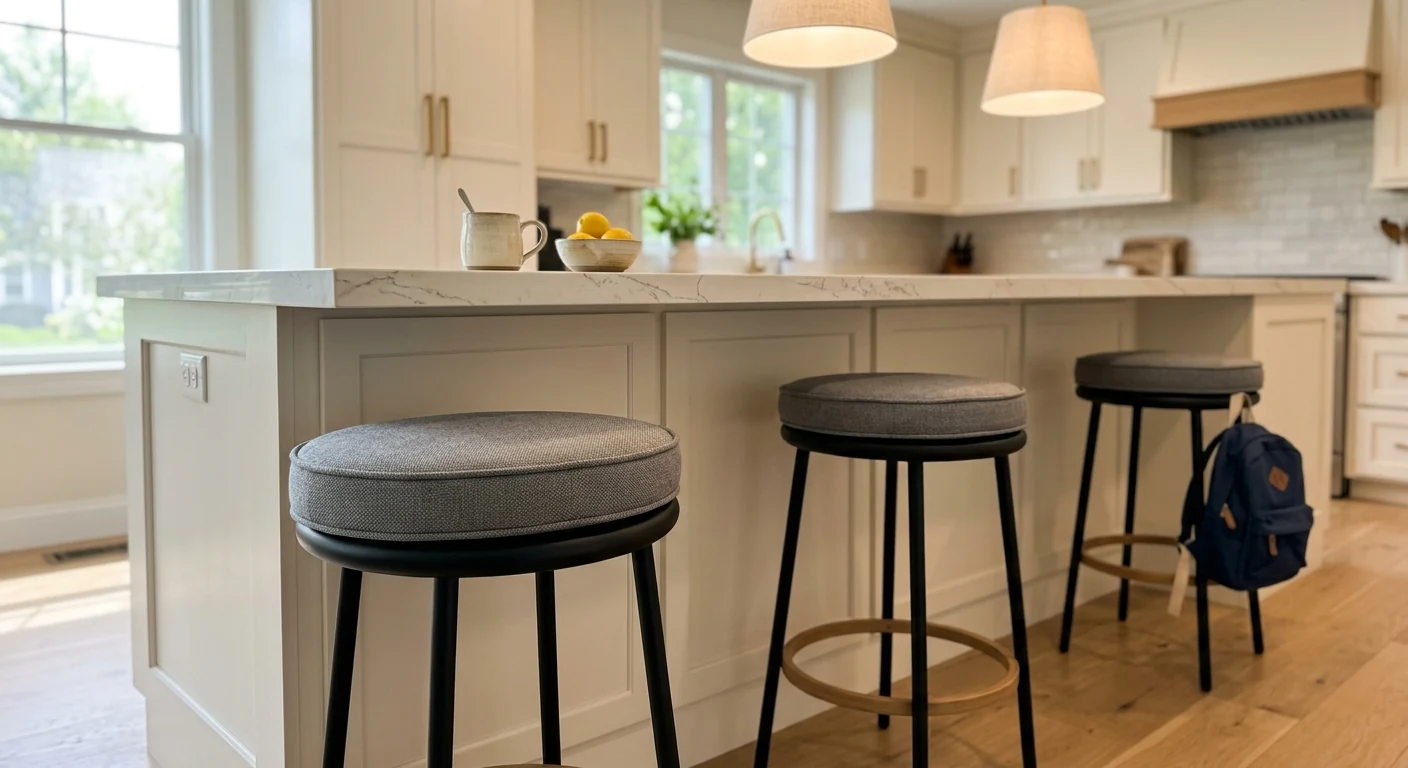
Our island is about nine feet long, and for the first two years nobody sat at it for longer than ten minutes. Everyone said it looked great. Nobody stayed. The stools were black metal with a thin wooden seat, nice enough to look at, and after one bowl of oatmeal your legs started going numb. Kids would perch for a snack and then drift off to the couch with their homework.
If that sounds familiar, you probably don’t need new stools. You need a cushion that actually fits them. That sounds simple, but bar stool cushions are one of those things where being off by an inch or two shows up immediately, either as a pad that slides around or one that hangs over the edge like a pancake on a saucer. So let’s go through the decisions in the order they actually matter.
Counter stool or bar stool? Check this before anything else
This one isn’t really about cushions, but it changes how thick a cushion you can get away with. A counter stool has a seat height of roughly 24 to 26 inches and goes with a standard 36-inch kitchen island. A bar stool sits at around 28 to 30 inches and belongs at a taller 42-inch bar. A lot of people have the wrong one for their island and just live with it, honestly.
Why does this matter for a cushion? Because every inch of padding lifts you off the seat. The usual rule is about 10 to 12 inches between the top of your seat and the underside of the counter. If you already feel tight against the island edge, stay on the thinner side. If your legs dangle a little, a thicker cushion can actually help.

Square or round: just follow the seat
There’s an urge to pick a shape you like and hope it works. Don’t. A round seat wants a round cushion, a square seat wants a square one, and a square seat with rounded corners wants a square cushion with the same rounded corners. A square pad on a round stool leaves four corners flapping in the air, and they will curl up within a few weeks of use.
The one place you have a bit of freedom is the corner radius on square seats. Many “square” metal stools have a gentle curve at the corners. If you tell us that radius when ordering a custom cushion, the pad follows the seat outline instead of sticking out at the corners, which is the main thing that makes a cushion look cheap.
The 12″, 14″ and 15″ question
These three numbers show up everywhere because they roughly match common stool seat widths. But “roughly” is the trouble. A stool that is labeled 14″ can have a seat that measures 13.5″ at the top and 14.5″ at the widest part of the rim. Measure the seat itself, with a tape, at the top surface, not the base and not the product listing.
| Seat width | Where you usually see it | Cushion approach |
|---|---|---|
| 12″ | Slim backless counter stools, small metal stools | Match the seat or go 1/2″ smaller; very tight room for error |
| 14″ | Mid-size wood and metal counter stools | Match the seat; a thin 1″ pad often looks best |
| 15″ | Larger round swivel and bar-height stools | Match the seat; 2″ thickness is more comfortable here |
As a rule, we’d match the seat edge to edge, or go smaller by no more than half an inch. Bigger than the seat is where the “too large” look comes from, and it also means the edge gets pinched or snagged when someone climbs on.

1 inch or 2 inches thick?
Thickness is a taste question as much as a comfort one, but there are some patterns. A 1″ cushion works if the seat is already slightly contoured, or you only sit for a quick coffee. It keeps the stool’s clean profile and doesn’t add much height. A 2″ cushion makes more sense when the seat is flat metal or hard wood and people sit for longer, like homework time or a long Sunday breakfast.
Past 2″ you start running into the clearance issue from earlier, and the stool begins to look like a pouf. The foam inside matters more than the extra half inch. A firm, dense core holds its shape for years, whereas soft filler flattens in a few months and leaves you sitting on the metal again. If you’re curious how this plays out over time, our FAQ page goes through how we build and what to expect from different cushion fills.
Ties or non-slip bottom?
I used to think ties were old-fashioned. Then I put a tie-less cushion on a swivel stool, and by the end of the week it had rotated about 20 degrees off the seat. So here’s how I’d think about it now.
Ties are the better choice when the stool has a back post, a spindle, or any gap you can tie around, and when kids are going to climb on and off many times a day. Non-slip bottoms are the better choice for backless stools with a flat, smooth seat, where there’s nothing to tie to, and when you want a clean look without strings.
If your stool has a slick powder-coated metal seat, a non-slip backing does most of the work but can still creep over months. In that case, a cushion with a slight edge over the seat rim (never more than a few millimeters) can help it stay put. If the stool swivels, ties are safer, period.

With a back or without?
Most kitchen island stools are backless, and a simple seat cushion is all they need. But if you or your family sit at the island for a long stretch, a stool with a low or high back changes the whole experience, because the seat pad does nothing for your lower back. For stools with backs, you can use a seat cushion and add a separate back pad, or look at something shaped like our custom high back chair cushions, which are made for exactly that seat-plus-back pairing.
On backless stools, the seat cushion will carry all the comfort, so I’d lean toward the thicker option there. Your back muscles are doing the work of holding you upright anyway.
Making sure the cushion doesn’t look huge
Three small things make most of the difference. First, edge-to-edge sizing, as covered above. Second, a fabric tone that isn’t wildly lighter than the stool, because a pale cushion on a dark seat looks bigger than it is. And third, a fabric that doesn’t show every crumb. Island seating is the part of the house where cereal gets dropped. Take a look at our cushion fabric options before choosing something light and delicate.
Piping or a boxed edge adds a defined outline that keeps the cushion looking tailored. Without it, a soft round pad can look like it’s melting off the seat after a few months of use.

How to measure, in about five minutes
Grab a tape and a pencil. Measure the seat top at its widest point, then the depth if it’s not round, and write down the corner radius if the corners are curved (the easiest way is to hold a coin or a small lid against the corner and note which one matches). Check the height between the seat and the island’s underside while you’re there. If you want to double check your numbers, our measuring guide shows each step with photos so you don’t have to guess.

Timing, and what to expect
Custom means made for your stools, so it isn’t a same-day thing. From the time you place the order to the cushions arriving at your door, it generally takes around 10 days. If you’re hoping to have the island ready before a holiday gathering or a back-to-school routine, it’s worth ordering a little earlier than you think you need to.
So, back to our nine-foot island. Once the cushions went on, the strangest thing happened: the kids started doing homework there on their own. Nobody asked them to. A pad on a hard stool is a small change, but it was the difference between a kitchen island that looks nice and one that people actually sit at. If yours is in the first group right now, browse our indoor cushions, send us your seat measurements, and we’ll take it from there.