

Most of us learn about cushion foam the hard way. The new bench cushion looks fantastic on day one, feels great for a few months, and then somewhere around year two there’s a permanent dip right where everybody sits. Nobody ordered a cushion with a built-in bowl.
That dip usually comes down to one spec that almost never shows up in product photos: foam density. It’s a big part of why one custom cushion still feels supportive after years of daily use while another gives up in a season or two. High density foam isn’t magic, and it isn’t right for every seat, but for the spots people actually sit on every single day it’s usually the smart call. Below is what the numbers really mean, how the main custom cushion foam types compare, and how to match foam to your bench, window seat or porch. (If you’re still at the tape-measure stage, start with our measuring guide first, because no foam can fix a cushion that’s the wrong size.)
What Is High-Density Foam (and What It Isn’t)
Density is just weight per volume. For foam it’s measured in pounds per cubic foot (lb/ft³), and a block of high density foam simply has more material packed into the same space than a block of budget foam. Pick up two blocks of the same size and the dense one feels noticeably heavier in your hand. That extra material is what lets it spring back after you stand up, day after day.

Here’s where people get tripped up: density and firmness are two different things. Firmness is measured separately, usually as ILD (indentation load deflection), which is basically how much force it takes to press into the foam by a set amount. You can have a high density foam that feels soft and plush, and you can have a low density foam that feels board-stiff for the first few weeks. That second one is the trap, it feels “supportive” when you test it in a showroom and then flattens out quickly.
Definitions shift a little from supplier to supplier, but as a rough guide, standard foam sits around 1.5 lb/ft³ or lighter, high density foam starts at roughly 1.8 and climbs from there, and high resilience (HR) foam is usually 2.5 or more with a livelier bounce. Treat those as ballparks, not gospel. If a seller won’t give you an actual number, that tells you something too.
Why High-Density Foam Matters for Custom Cushions
Superior Comfort & Support
A cushion’s real job is to hold your weight without letting your hips bottom out on the hard surface underneath. Low density foam compresses fast under load, and once it does you’re basically sitting on plywood with a fabric cover on top. High density foam pushes back more evenly, so pressure spreads across the seat instead of concentrating under your sit bones. That matters more than you’d think on a bench where you sit through a full dinner, or a window seat where somebody reads for half a Sunday.
Exceptional Longevity & Resilience
Foam doesn’t fail all at once. It loses resilience gradually, the tiny cell walls fatigue every time they’re compressed, and eventually they stop bouncing back. Denser foam has more material in those cell walls, so it fatigues more slowly. As a rough real-world guide, budget foam under daily use often starts showing body impressions within a year or two, while good high density foam commonly holds up for five to ten years, depending on how much weight it carries and how much sun and moisture it sees.

So, how long does high density foam last? There isn’t one number, and anyone who promises one is guessing. Sunlight, humidity, a household of heavy daily sitters versus a guest bench used twice a year, all of it moves the timeline. What you can count on is that the same seat will outlast a low density version, often by several years, and that’s usually where the higher price pays for itself. If you’re shopping for durable replacement cushion foam because the last set went flat, this is the spec to go up a notch on. Swapping a worn-out core every couple of years costs more, and is more annoying, than buying the better one once.
Better Fit for Custom Shapes & Sizes
This is the part that’s specific to made-to-measure cushions. A custom high density cushion insert is cut to your dimensions, so it can follow the exact seat: angled corners for a bay window, a notch around a radiator cover, a slightly rounded front edge so it doesn’t dig into the back of your thighs. Dense foam holds those cut edges crisply. Soft low-density foam tends to slump and round off at the corners, and that’s when the cover starts to wrinkle and pucker. On a bay window, where three or four angles have to meet cleanly, that crispness is the difference between a cushion that looks built-in and one that looks like it wandered in from another room. It’s exactly why our custom bay window cushions are made to your measurements instead of a standard size.

High-Density Foam vs. Standard Foam: A Quick Comparison
Here’s the short version side by side. The figures are typical ranges rather than promises, so read them as directional.
| Standard foam | High density foam | High resilience (HR) foam | |
|---|---|---|---|
| Typical density | About 1.5 lb/ft³ or lighter | Roughly 1.8 to 2.5 lb/ft³ | 2.5 lb/ft³ and up |
| How it holds up | Body dips often show within 1 to 2 years of daily use | Slow to lose its shape, edges stay crisp | Springiest rebound, feels lively |
| Typical lifespan (daily use) | 1 to 3 years | 5 to 10 years | Often 8 to 10+ years |
| Best for | Decorative or occasional-use seats, guest chairs | Daily benches, window seats, dining chairs | Heavy-use seating where you want premium comfort |
| Price | Lowest | Mid-range | Highest |
Try this at home: press your palm firmly into the middle of a seat cushion, hold for a second, then let go. Good high density foam gives a shallow dent and bounces back within a second or two. A cushion that stays dented, or that lets your hand sink almost to the bottom, is telling you it’s already tired.

One more thing, because it trips people up: the cover and batting change how the same foam feels. A wrapped layer of polyester batting softens the edges and gives that plump, tailored look, and a heavier woven fabric feels firmer than a slick performance fabric. So when you’re comparing two cushions, compare the foam spec first and the cover second. Our cushion fabric page walks through how the different covers behave.
How to Choose the Right High-Density Foam for Your Custom Project
Skip the generic advice. The right foam depends on where the cushion will live and who’s going to be sitting on it, so let’s go through the three spots we see most.
Best foam for custom bench cushions
Kitchen and entryway benches take the most punishment: shoes on and off, backpacks dropped, someone perching for ninety seconds twenty times a day. For these, high density foam in a medium-firm to firm feel is the safe pick, and 3 to 4 inches thick is a common range. If it’s a dining bench where people stay put for a whole meal, lean toward the 4-inch end with a slightly softer surface, so it’s comfortable at minute forty and not only at minute one. That balance is what makes comfortable custom bench cushion foam, and it’s what we build into our custom bench cushions.
Firm high density foam for window seats
Window seats are tricky because they’re really two seats in one: upright sitting in the morning, half-lying with a book in the afternoon, maybe a nap on a rainy Saturday. A firm high density core keeps your hips from sinking down to the board, and 4 inches is a nice thickness if you actually lounge there. If the window gets direct afternoon sun (south-facing bays definitely do), think about the cover too, since sun fades fabric quicker than it ages the foam inside.
What density foam is best for outdoor cushions?
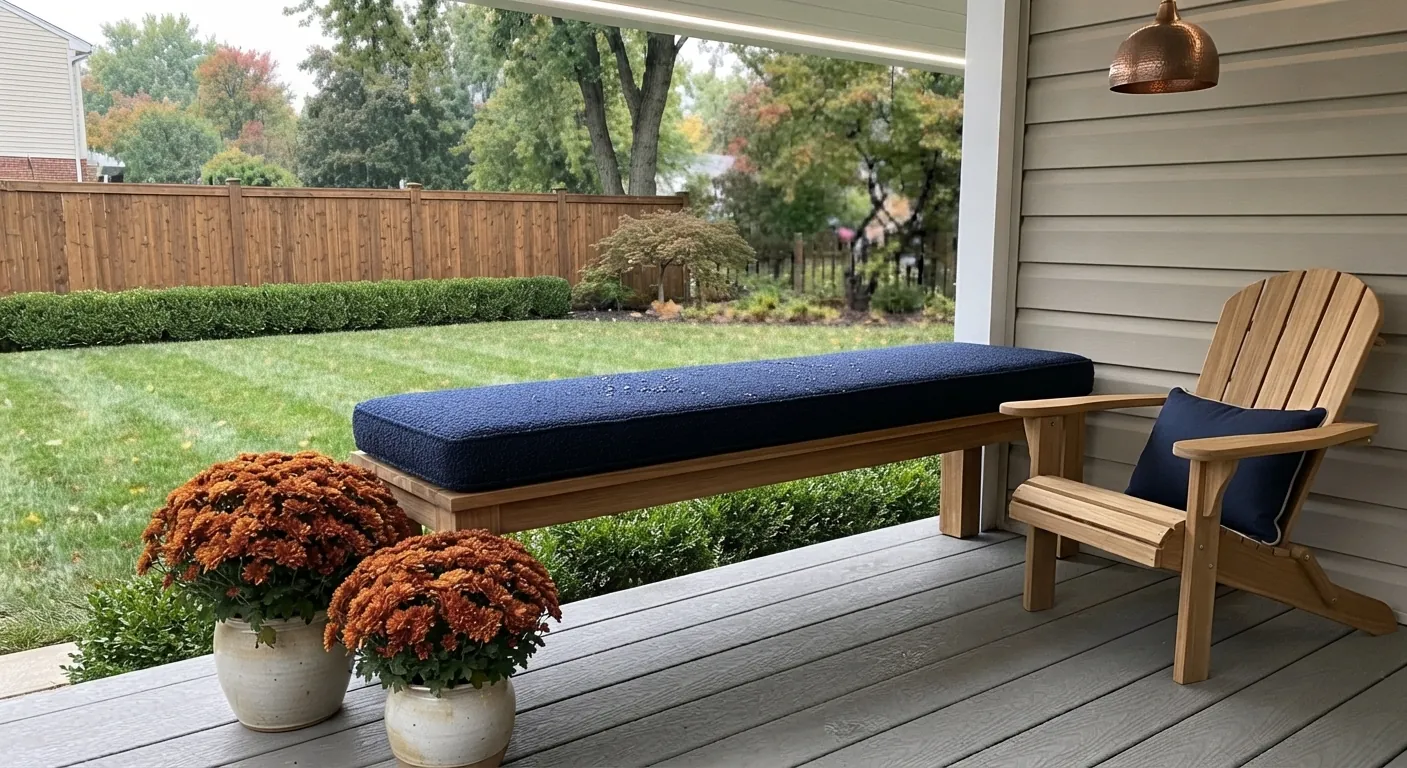
Outdoor is the one place where density alone won’t save you. Regular foam is open-celled, which means it soaks up water like a sponge and then takes forever to dry, and that’s how you end up with musty porch cushions by October. Look for high density foam, roughly 2.0 lb/ft³ or above, so the seat still supports you, and pair it with a water-resistant, quick-drying cover. For spots that get rained on a lot, a quick-dry (reticulated) foam that’s built to drain is worth asking about. Fall is honestly a good time to think about all this, since it’s easier to sort out which porch cushions deserve replacing before they get shoved in the garage for winter. You can see what’s available in our outdoor cushions collection.
Quick Answers to Questions People Ask a Lot
Is high density foam good for cushions?
For anything you sit on regularly, yes, it’s one of the better upgrades you can make. It supports your weight more evenly and keeps its shape far longer than standard foam. The one time it’s overkill is a seat that barely gets used, like a guest room accent chair, where cheaper foam will last just fine.
Will high density foam feel too hard?
Not necessarily, and this circles back to the density-versus-firmness point. Density tells you how long the foam will last, firmness tells you how it feels. Plenty of high density foams come in soft and medium grades. If you like a plush seat, look for a softer firmness rating (ILD) rather than dropping down to a lower density.
How can I tell what’s actually inside a cushion?
Ask for two numbers: density in pounds per cubic foot and a firmness or ILD rating. If a seller only says “premium foam” or “extra firm”, that tells you very little. And if you can hold the cushion, the heavy-for-its-size test works surprisingly well, because dense foam feels heavier than you expect and springs back quickly when you press and release.
The Short Version, and What to Do Next
If you sit on it every day, pay for the density. If it lives in a guest room and sees two visitors a year, don’t bother. That’s honestly most of the decision, and everything else (thickness, firmness, cover) is fine-tuning around it.
It’s also worth being upfront about timing. Custom cushions are made after you order, not pulled off a shelf, so plan on roughly 10 days from checkout to your doorstep. With Thanksgiving hosting on the horizon and the first chilly evenings pushing everybody toward the window seat, ordering in the next few weeks leaves you comfortable breathing room.
When you’re ready, browse our custom cushions, pick your shape, size and fabric, and you’ll end up with something that still feels good long after the novelty wears off. Measure twice, order once, and enjoy the seat.