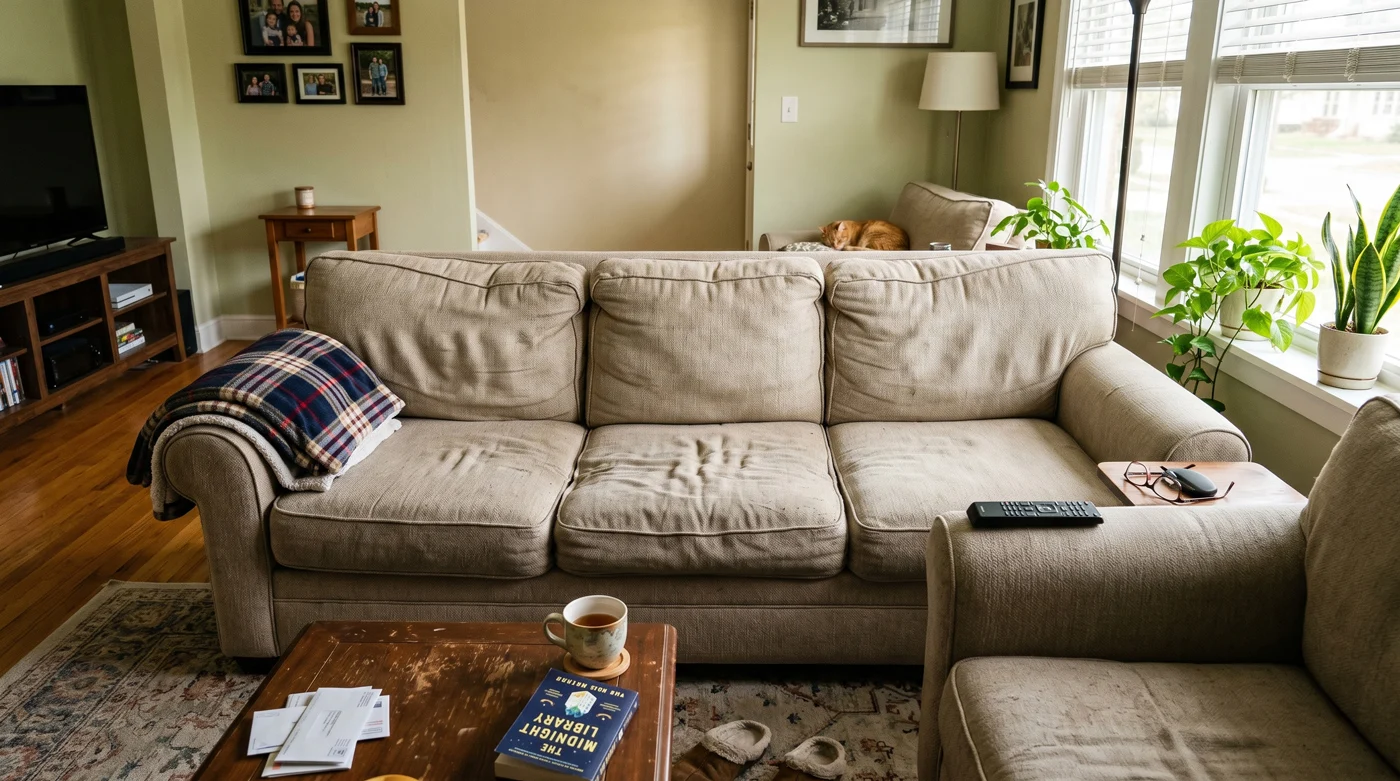
The cushions have finally given up. You press your hand in, count to ten, and the dent just stays there. The frame is fine, the fabric is fine — it’s the foam that’s gone, and you’d rather not replace a perfectly good sofa over it.
So: foam replacement. Reasonable instinct. This article covers where to actually buy it, what you need to know before you do, and — further down — why a meaningful chunk of people who start this process end up going a different direction entirely. Both paths are legitimate. The goal here is to give you enough information to pick the right one for your situation.
Part One: The Foam Itself
Understanding Foam Types Before You Buy
Walk into a foam purchase without knowing these distinctions and you’ll likely end up with something that’s either too soft after three months or so firm it belongs in a commercial waiting room. The three main categories for couch cushion replacement:
| Foam Type | Density Range | Typical Lifespan | Best For |
|---|---|---|---|
| Standard Polyurethane | 1.5–2.0 lb/ft³ | 3–5 years | Guest room sofas, occasional seating |
| High-Density (HD) | 2.0–2.8 lb/ft³ | 7–10 years | Daily-use sofas, family rooms |
| High-Resilience (HR) | 2.5–3.0 lb/ft³ | 12–20 years | Heavy daily use, premium replacements |
| Memory Foam | 3.0–5.0 lb/ft³ | 5–8 years | Back cushions, occasional seating — not ideal as a seat foam |
| Dry-Fast / Reticulated | 1.8–2.2 lb/ft³ | 5–7 years | Outdoor cushions only — drains water, resists mildew |
A note on memory foam specifically: it’s slower to recover after you sit, which feels luxurious for the first few weeks and then increasingly annoying as a primary seat foam. It also runs warm. Most upholstery professionals recommend HR foam for seat cushions and reserve memory foam for back cushions or toppers at most. Sailrite’s foam guide goes into the engineering behind this in more detail if you want the full picture.
The other number that matters is ILD (Indentation Load Deflection) — the firmness rating. Typical sofa seat cushions run 35–50 ILD. Lower feels softer, higher feels firmer. Density and ILD are independent variables: a foam can be high-density (durable) but low ILD (soft feel), which is actually the sweet spot for a daily-use seat cushion.
Where to Actually Buy It
There are three realistic channels, each with different tradeoffs:
Online foam specialists. The most common route for DIYers. Companies like Foam Factory, FoamByMail, and FoamOrder let you specify exact dimensions and foam type, then cut and ship to order. Selection is wider than any physical store, and detailed spec sheets are usually provided. The tradeoff: you’re choosing blind on feel — you can’t sit on it before buying, and returns on custom-cut foam are typically not accepted. Getting the density and ILD wrong is an expensive mistake with no good remedy. FoamByMail’s type comparison is one of the clearer resources for navigating these decisions before you commit.
Local upholstery shops. Underused and underrated. A good upholsterer will let you feel different foam samples in person, can cut to your exact dimensions on-site, and will flag things an online order form won’t — like whether your cushion cover construction requires a specific foam profile, or whether the cover itself needs replacing too. Pricing is comparable to online specialists once you factor in shipping weight. The main drawback is availability: not every area has a well-stocked upholstery supplier, and finding one may take some effort.
Craft and fabric chains. JOANN, Hobby Lobby, and similar stores carry upholstery foam, but selection is limited and what they stock rarely exceeds 2.0 lb/ft³ density. Fine for low-traffic decorative cushions. For a family room sofa that gets daily use, you’ll likely be replacing it again in two or three years.

Part Two: What the DIY Process Actually Involves
This part tends to get glossed over in foam-buying guides, which makes sense — they want to sell foam. But it’s worth being honest about what you’re signing up for before you order.
The steps, plainly stated
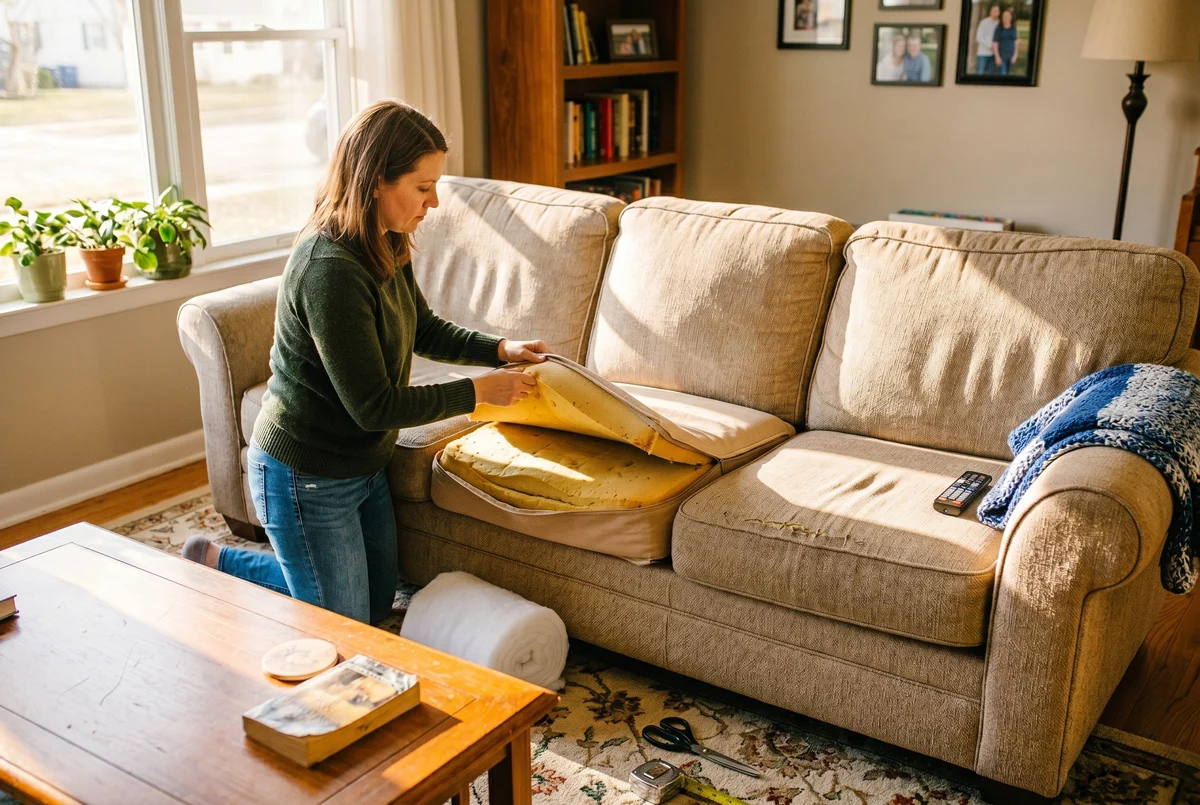
First, you need to confirm the cushion cover has a zipper or accessible seam. Attached or sewn-shut covers require cutting open and re-sewing — that’s a separate skill set. If your cushions don’t have removable covers, foam replacement is effectively off the table without a professional upholsterer.
Assuming the covers are accessible: remove the old foam, measure the cover from interior seam to interior seam in all three dimensions (length, width, thickness), and add about half an inch to length and width for a snug fit. Do not measure the old foam — it has compressed and will give you inaccurate dimensions. Order the new foam. Wait for delivery (typically 1–2 weeks for custom-cut orders).
When it arrives: wrap the foam in Dacron batting (polyester fiber) before inserting into the cover. This step is non-optional if you want the cushion to look full rather than flat — the batting rounds the edges, fills out the cover, and prevents the fabric from sliding on the foam. Apply spray adhesive at the top and bottom edges to hold the batting in place. Then compress the foam, slide it into the cover using a plastic bag trick (the bag reduces friction against the fabric), remove the bag, and zip closed.
On a three-seat sofa, with three seat cushions and potentially back cushions as well, this is a half-day project at minimum. If any measurement is off, or the foam density doesn’t feel right once it’s inside the cover, options are limited.
Where things go wrong most often
Measuring the old compressed foam instead of the cover interior. Choosing density based on feel-in-hand rather than sitting experience. Skipping Dacron batting and ending up with a flat-looking result. Ordering from a non-returnable supplier and discovering the firmness is wrong. T-shaped or L-shaped cushion profiles require templates and add complexity most guides understate.
Part Three: When People Skip the Foam Entirely
Here’s what the foam-buying guides don’t mention: a meaningful number of people who start researching replacement foam end up going a different direction — not because the DIY route doesn’t work, but because their specific situation makes it less attractive than it initially seems.
The scenarios where this happens most often:
The sofa frame is fine but the cushion is fundamentally the wrong fit. If a sofa bench seat has always been a bit too deep, or the cushion was the wrong thickness from the factory, replacing the foam with the same dimensions just recreates the original problem. This is when people start looking at custom-made cushions rather than foam inserts.
The cushion covers are also worn. Faded, stained, or thinning fabric means you’re not just replacing foam — you’re replacing covers too. At that point the cost and effort of a full DIY rebuild starts to approach the cost of a finished custom cushion ordered to size, without the uncertainty of the DIY outcome.
The surface isn’t a sofa at all. A lot of searches for “foam for couch cushions” come from people with dining benches, window seats, entryway benches, or built-in patio seating — surfaces that are loosely described as “couch-like” but are actually bench cushion territory. For these, a finished custom cushion made to the exact measurements of the surface is almost always the cleaner solution than sourcing raw foam and fabricating something from scratch. The measuring guide takes five minutes and confirms exactly what you need.
The math on time vs. cost changes the calculation. A full DIY foam replacement on a three-seat sofa — foam, batting, spray adhesive, delivery wait, and the installation time — runs roughly $80–$180 in materials, plus several hours of work and the risk of a mis-order you can’t return. A finished custom bench cushion, cut to your exact measurements with your choice of fabric and foam density, delivered ready to use, often lands in a comparable price range without the project overhead. Custom cushion options — indoor, outdoor, bench, and tufted — are worth looking at before you commit either direction.

The Decision, Simply
Buy foam if: your sofa has removable cushion covers in good condition, the dimensions are straightforward (no T-shapes or unusual profiles), and you’re comfortable with a half-day project that carries some risk of needing a redo. High-resilience foam at 2.5 lb/ft³ or above is the right spec for daily-use seating — anything below 1.8 lb/ft³ is a short-term fix.
Consider a finished custom cushion if: the covers are also worn, the surface is a bench rather than a sofa, the original fit was never quite right, or the time-and-risk tradeoff of DIY doesn’t appeal to you. For bench seating specifically — custom bench cushions and outdoor versions are built to your dimensions from the start, with fabric and foam density chosen upfront, and arrive ready to use. No Dacron, no spray adhesive, no measuring errors.
Neither option is universally better. The right one depends on what you’re actually working with.