
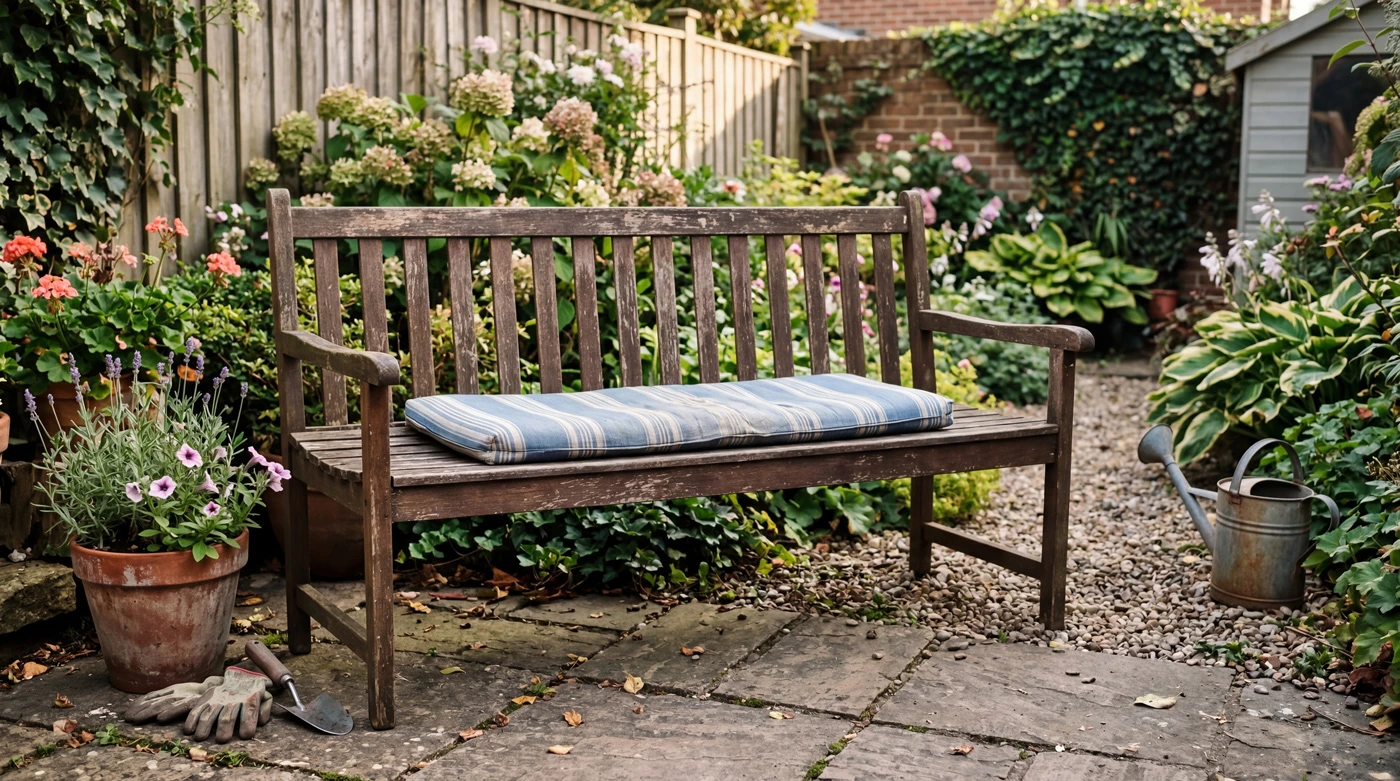
You measured. Twice, actually — because you’re the type of person who learns from past mistakes. You found something close enough online, read the reviews, added it to your cart. It arrived, you unboxed it with reasonable optimism, carried it outside, set it on the bench, and… silence. Three inches of bare wood on each end. Or it’s technically the right length but somehow puffs up in the middle like a sad croissant. Or it fits fine until someone actually sits on it, at which point it migrates slowly toward the edge like it’s trying to escape.
You are not bad at measuring. Your furniture is not broken. The problem is that “standard size” outdoor cushions aren’t really standard at all — and nobody in the retail cushion business is particularly motivated to tell you that.
“Standard” Is Doing a Lot of Heavy Lifting as a Word
Here’s what “standard” actually means in the outdoor cushion world: it means the sizes that are cheapest to manufacture at scale. Retail cushions typically come in sizes ranging from 12 to 24 inches on each dimension, with bench cushions clustering around a handful of common lengths — 42″, 48″, 52″, 60″. Those numbers weren’t chosen because they match the most common furniture dimensions. They were chosen because they’re easy to produce, easy to stack, and easy to ship.
Your furniture, meanwhile, was designed by someone who wasn’t thinking about cushion inventory. Outdoor bench cushions in the U.S. alone tend to fall anywhere between 44 and 60 inches long, with seat depths from 18 to 20 inches — and that’s just for “standard” outdoor benches. The moment you introduce a built-in, a vintage piece, a custom-built garden bench, or anything bought more than five years ago from a brand that’s since discontinued that model, you’re essentially on your own.
The honest version of this situation: manufacturers’ printed dimensions refer to the outermost measurements of the furniture, not the seat surface itself — which means even when you measure correctly and match the number on the tag, the cushion still might not sit the way you expected. This is the part they don’t put in the product description.

The Three Ways This Goes Wrong (Pick Your Fighter)
There are basically three flavors of cushion-fit failure, and if you’ve been through this more than once, you’ve probably collected at least two of them.
The too-short cushion. This is the most common one. The cushion is technically the closest available size to your bench, but “closest” means there’s a gap at each end where the wood is just… there. It looks unfinished. It feels unfinished. Every time you sit near the end, your thigh finds the edge of the frame instead of the cushion, which is both uncomfortable and weirdly personal. The cushion also has nothing anchoring it at the ends, so it drifts toward one side over the course of a single afternoon.
The too-long cushion. Less common but arguably worse. The cushion extends past the bench frame on one or both ends, which means the overhang bends slightly downward under its own weight. That bent section is now a perfect water-collection zone. After a couple of rainstorms, the underside of the overhang starts to develop that particular smell that no amount of outdoor cushion spray fully removes. The foam in that section also compresses faster because it’s unsupported, so within a season you’ve got a cushion that’s visually and structurally uneven.
The “close enough” cushion that isn’t. This one is the sneakiest. It fits — technically. But it’s half an inch narrower than the seat depth, so there’s a thin strip of frame visible at the back. Or it’s the right length but slightly thicker than the arms allow, so the whole thing sits at a very subtle angle. Or the foam density is wrong for the weight distribution on your particular bench, and it develops an off-center indent that you can never fully re-fluff. You don’t return it because it’s not wrong enough to justify the hassle. It just quietly bothers you for three years.
Quick gut check: if you’ve ever described a cushion as “it works fine” while slightly narrowing your eyes, that’s the third one. You know which cushion I’m talking about.

The Furniture That Almost Never Fits Standard Cushions
Some furniture is almost designed to make this difficult. Not intentionally — it’s just a byproduct of how it was made, sourced, or aged into your life. If any of the following sounds familiar, you already know standard sizing isn’t going to save you.
Older furniture from brands that discontinued the cushions. This is probably the single most common source of the problem. You bought a nice set five or seven years ago, the cushions finally gave out, you went to replace them — and the manufacturer no longer makes that model’s cushion. The dimensions were proprietary anyway. Now you’re matching a ghost.
Inherited or vintage pieces. Your grandmother’s wrought iron bench. The teak garden set from someone’s estate sale. A solid wood bench that was clearly built by someone who did not consult a cushion catalog. These pieces are often beautiful and genuinely well-made, which makes it even more frustrating that nothing fits them properly.
Built-in outdoor benches. Deck benches, pergola benches, built-in seating around a fire pit — these were built to the dimensions of the space, not to any cushion standard. They’re often slightly irregular in depth, sometimes with a slight taper, sometimes with an angle at the back that means the cushion needs to sit in a specific way to look right.
Imported furniture. Furniture manufactured outside the US is often built to different dimensional conventions. A “48 inch” bench from a European or Asian manufacturer may actually measure 47.2 inches — close enough to list as 48″, not close enough for a US standard cushion to fit well.
If your bench falls into any of these categories, the outdoor cushion options worth looking at first are the ones made to your measurements — not the ones you’re hoping will be close enough.

Why Custom Is Less Complicated Than You Think
The word “custom” makes people picture lengthy phone consultations and a six-week wait. That’s not what this is. The actual process is: measure your bench, enter three numbers, pick a fabric, order. That’s it.
The three numbers are length, depth (front to back), and thickness. Measure the seat width from left to right across the frame, and the depth from the front edge to the rear where it meets the back — using a rigid tape measure, not a fabric one, which can flex and give you an inaccurate reading. Thickness is usually a matter of preference and clearance (if you have armrests, you need the cushion to sit below them). If you’re unsure, the measuring guide walks through each step with diagrams, and it takes about five minutes.
The fabric choice is where custom actually gives you something standard retail can’t: control. For outdoor use, what you’re looking for is solution-dyed fabric — where the color is embedded in the fiber during manufacturing rather than applied to the surface afterward. This is the difference between a cushion that holds its color through three summers and one that starts fading after the first. The fabric guide breaks down exactly what the options mean in practical terms, without requiring you to know what “solution-dyed acrylic” is before you start reading it.
Lead time is typically one to two weeks. Which is, for context, less time than most people spend measuring the wrong cushion, ordering it, waiting for it, discovering it doesn’t fit, deciding whether to return it, eventually returning it, and starting over.

What to Actually Look for When You Order
Whether you go custom or give retail one more try, there are a few things worth checking before you commit.
On foam density: the industry standard for outdoor cushion foam runs between 1.5 and 1.8 lbs per cubic foot — below that and you’re buying something that will compress noticeably within a season. If density isn’t listed anywhere on the product page, that’s usually a sign it’s on the lower end and they’d prefer you not know.
On fabric: look for whether it’s solution-dyed or surface-printed. Surface treatments fade faster and can crack or peel at the seams over time. This information is sometimes buried in the specs tab and sometimes not listed at all — if you can’t find it, it’s probably not solution-dyed.
On seams: piped or double-stitched seams hold up significantly better outdoors than flat-stitched edges. The seam is the first place water infiltrates and the first place fabric stress concentrates when someone sits. It’s worth looking at.
The custom outdoor bench cushion page has fabric and construction specs listed clearly, which is more than most product pages bother with. If you have a specific bench situation — tapered, curved, built-in, or just an unusual measurement — the product page is a good starting point for figuring out whether custom makes sense for your setup.
Before you order anything: a quick checklist
| Measure the frame | Not the old cushion — measure the actual seat surface of the furniture |
| Note any taper | Measure depth at the front edge and again at the back — they’re often different |
| Check clearance | If there are arms, measure the height from the seat frame to the underside of the arm |
| Fabric type | Solution-dyed for outdoors; surface-treated fades fast |
| Foam density | 1.8 lb/ft³ minimum for regular outdoor use |
The Part Where I Tell You to Stop Settling
Here’s the thing about the “close enough” cushion: it’s actually more expensive than the right one. You buy it, it’s wrong, you live with it for a season or two because returning things is annoying, then you replace it. That’s two cushions worth of money for one cushion’s worth of satisfaction.
A cushion that actually fits your bench — in the right length, right depth, right thickness, right fabric — doesn’t just look better. It stays where it’s supposed to be, it wears evenly, it cleans up properly, and you stop noticing it in that background-irritation way you’ve been noticing the current one. That’s a pretty good return on a few extra minutes of measuring.
Browse the full range of custom cushions — or go straight to the outdoor bench cushion page if you already know what you’re dealing with. Either way, bring your measurements. Three numbers. That’s all it takes to stop buying the wrong size.